

Why Does The New York Times Keep Telling You Alcohol Will Kill You?
It’s not a temperance campaign — it’s a business model

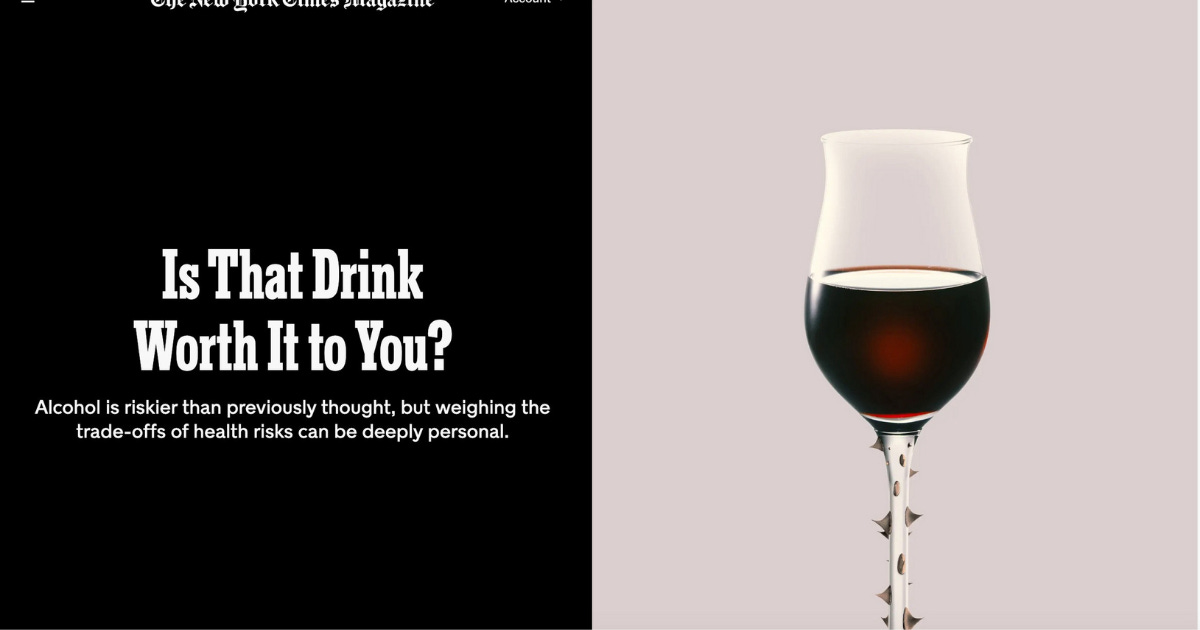
Another day, another anti-alcohol article from The New York Times, this time about all the terrible things a small sip of alcohol will do to your body.
It arrived just two days after an article on how socialising with alcohol is bad for you too.
Why has the world’s paper of record decided to publish so many stories about how awful alcohol is — and when will it end?
Inside the New York Times
Back in 2018, I was lucky enough to join a Poynter tour of American media. At the time I was editor-in-chief of what was then Meininger’s Wine Business International, and I’m not sure how a trade editor made the cut; the tour was otherwise made up of people like a renowned Argentine that Marty Baron, then editor of the Washington Post, leapt up to greet.
But I did my bit for journalism, as I was put in charge of choosing the wines for dinner.
The Poynter Institute, a not for profit media institute, had become alarmed at the state of news. On our first day, we were given a presentation showing how corruption rose when local reporting disappeared, leading inexorably to anger, then to populism and finally to democratic decline. Poynter’s goal was to show us how to become profitable, so we could go back to our home countries and try and arrest the process.
That meant a week of immersion in America’s most storied media outlets. For a journalism junkie, it was the week of a lifetime. We went from one major outlet to another, and everywhere we went, people gave us strategies and hard numbers.
On the last day, we crossed the street from our hotel to meet Arthur Sulzberger, fifth-generation publisher of the New York Times. This was the era of Trump’s “fake news” accusations, when the media faced increasing numbers of credible bomb threats. We had to skirt the concrete blocks at the entrance, erected to stop vehicles ramming the foyer, and then do an identity check and pass through a metal detector. Then we trooped past a wall of Pulitzer Prizes on our way to the meeting room.
That the New York Times is so successful today while so many other outlets have closed is thanks to a seminal paper that Sulzberger wrote back in 2014. That Innovation Report turned the Times from a classic newspaper into a digital first, audience-driven outlet. (Naturally, a journalist instantly leaked the Report.)
Sulzberger had a lot of interesting things to say about mission and responsibilities, but the most memorable presentation of the day was from Cliff Levy, overseer of the digital transformation. Levy’s presentation showcased the work of their data scientists and explained how the information was used.
In short, they know what their audience wants and they know how to deliver.
The audience and the algorithm
The NY Times is nearly unique in legacy media in attracting readers of varying ages. It has a sizeable 55+ audience wanting tips on how to stay healthy while aging, plus highly-educated younger readers seeking information on self-optimisation. This comes on top of the general interest in health and wellbeing that has intensified in the wake of Covid.
All of this means that Well, which covers everything from diet to cancer, is one of the newspaper’s most popular sections.
The NY Times is also not above writing SEO articles — they look at what people are searching for online, and then spin up an article about it, so all those queries lead straight to them. That’s how you get deep dives into haemorrhoids on the home page.
Health stories about alcohol drive particularly high engagement, as is obvious by the volume of comments. This incentivises editors to produce more of them.
The NY Times is not a clickbait factory. They take their “first draft of history” responsibility seriously; Levy described how the app will push pictures of starving Yemeni orphans to the top, “despite the fact that we knew in every fibre that people would want to look away.” Even their SEO-bait stories are fleshed out.
But they are in the business of attention — and alcohol and health stories get attention.
The individual versus the institution
Then there is reporter Roni Caryn Rabin, whose writing on the topic has been unusually consequential; in 2018, her reporting brought down the $100 million MACH trial, which would have been the definitive randomised control trial on alcohol and health. She’s since written stories which take a clear position that any suggestion that moderate drinking might be benign or even beneficial is highly questionable.
I couldn’t possibly know why a specific journalist pursues a particular angle, but I do know that the interests of one reporter don’t represent the institution, regardless of how many stories they produce, simply because big media outlets function like old-fashioned bazaars, where everybody is haggling at high volume over what stories to do next.
What’s probably happening is that editors with access to the analytics can see that alcohol and health stories perform well, so they green light them when pitched. Individual interests and institutional incentives head in the same direction, and the result looks like a coordinated campaign, even when it isn’t.
The end result, though, is that media coverage at this level shapes the environment in which policy decisions are made. Persistently hitting the same notes can make particular regulatory ideas seem inevitable, while narrowing the range of voices that are considered legitimate. Over time, that shifts the debate.
Unfortunately, because Rabin’s reporting is seen as biased and unfair by the wine, beer and spirits sectors, many senior executives (and some of the most significant medical experts on alcohol) now ignore media requests from the New York Times — which means the industry is increasingly absent from the conversations shaping broader cultural narratives.
(There are heroic exceptions, particularly Dr Laura Catena and Amanda Berger PhD from DISCUS.)
For all that, I think the era of relentless anti-alcohol stories is coming to a close.
Take a look at the comments
Obviously I can’t see the analytics, which may tell a different story, but if you look at the number of comments left by readers, it appears engagement is falling; a September 2024 article that was sceptical about red wine’s health halo got nearly 2,000 comments. Rabin’s recent article about alcohol and socialising got a mere 190. This could be a signal that readers are getting tired of the subject.
Beyond the engagement question, the paper has pretty much tapped out the topic although one reporter has said that she’s working on an alcohol and dementia story.
But you never know. If the Well stories continue, this is what I would predict:
Alcohol and brain health;
Sports performance and alcohol;
Alcohol and sleep (maybe woven into a story on sleep);
Quirky breaking stories like this one on spirituality and alcohol.
Other than that, it’s probably slim pickings until the US Dietary Guidelines come round again in five years, unless there’s some big scandal.
When the incentives shift
The reporting itself deserves a separate and lengthy post, but suffice it to say the industry has legitimate grounds for some of its frustration. Still, I don’t think the New York Times is institutionally prohibitionist; they recently did an excellent story on the deadly consequences of Australia’s terrible tobacco policies.
What will be interesting to watch is how they handle the evolving cannabis story, in light of the Trump Administration’s signals that it wants to normalise its medical use. Cannabis is popular among the New York Times’ demographics, particularly among Baby Boomers.
But it’s not as medicinally beneficial as often claimed nor as harmless. In jurisdictions where cannabis laws have been liberalised, autopsies are increasingly detecting it in drivers involved in fatal accidents, while its use has been associated with rising admissions for drug-induced psychosis.
It will be a test of what happens when a publication reliant on subscriber goodwill must also fulfil a mission to report on the big issues of the day — when they know their readers won’t like it.
As for alcohol, it will remain an attractive topic until interest wanes. The coverage will follow the incentives, rather than ideology.
When the incentives shift, so too will the stories. Which may already be happening.
Post-publication note
I had a query in the comments about why I didn’t tackle the question of whether the stories are accurate or not, so I guess other people are wondering this.
What I set out to do was to ask why alcohol-and-health stories are so prevalent, focusing on newsroom incentives and audience demand, not to adjudicate the scientific accuracy of individual claims about alcohol’s health effects. That’s a major question that needs its own article. But yes, I have views about the reporting, as per my comment.
I do intend to look at the claims at another time.
It's worth noting that a common pattern in advocacy circles (and that is indeed the circle we are talking about here with regard to the NYT coverage) is to double down in more extreme ways when current coverage is not garnering the kind of attention it has in the past. What I think this likely means for coverage at the NYT is a focus on the alcohol industry and the ways it harms American society.
I sense that a new Puritan age is well underway. Scolding, competitive purity, etc. are all the rage. Add the online-generation high anxiety; a terror of the realities of life. If I'm pure, I'll never die, never be vulnerable, wrong etc.